Introduction
When space is limited, carrying a collection of separate outdoor tools can quickly become inconvenient. A camping trip, vehicle emergency kit, hiking pack, or general household toolbox may require several different functions, but carrying a separate hammer, pliers, saw, screwdriver, cutting tool, fire-starting accessory, and other equipment is not always practical.
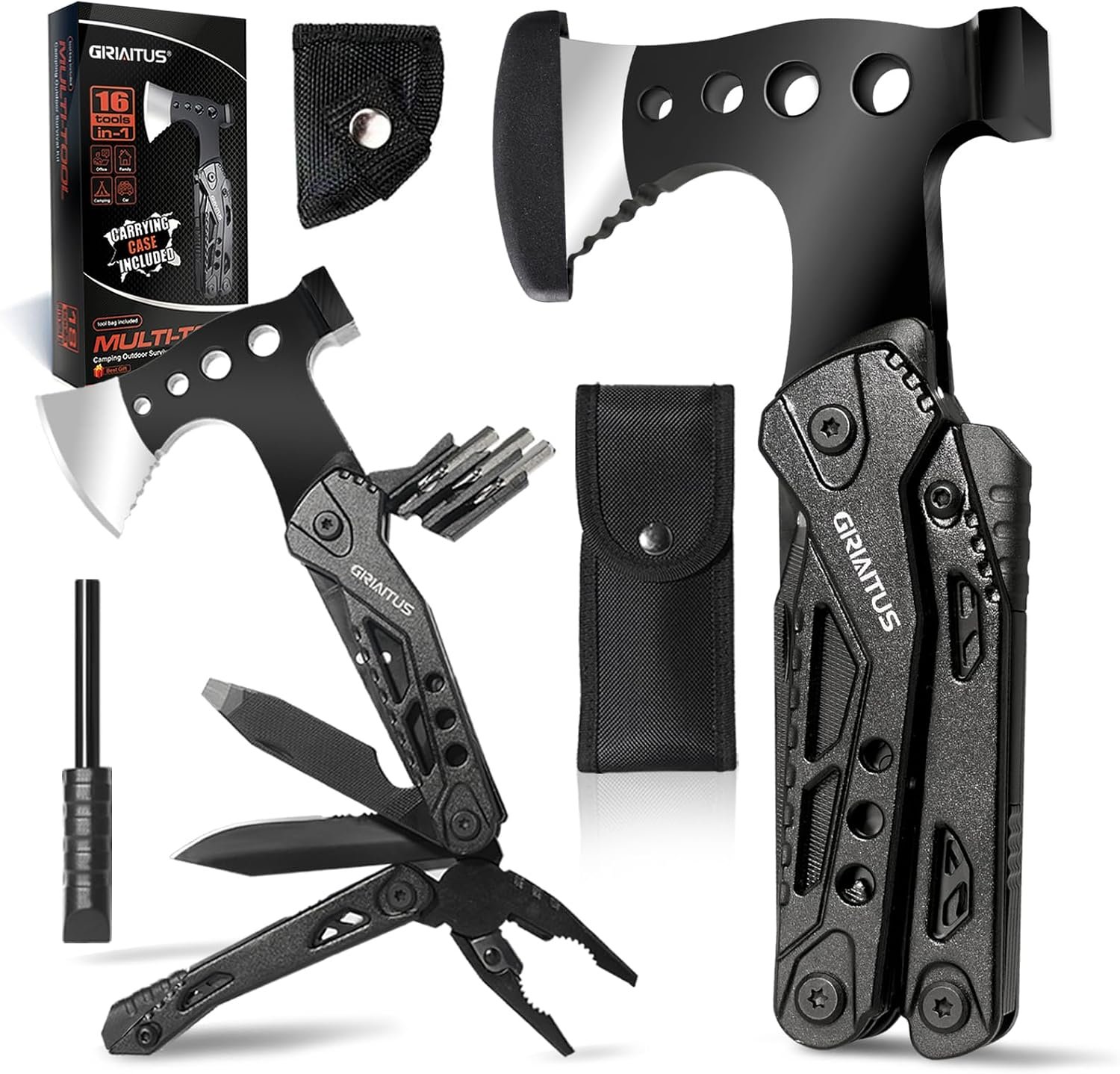
The 16-in-1 multitool associated with Amazon ASIN B08ZM2KC49 takes a different approach by combining multiple functions into one compact folding tool. The product is identified as a GIRIAITUS 16IN1 model and is built around a stainless-steel multi-tool design. Its listed functions include an axe, hammer, nail claw, pipe-grip pliers, wire cutter, needle-nose pliers, knife, saw, serrated blade, file, flathead screwdriver, Phillips screwdriver, whistle, flint fire starter, bottle opener, and carrying case.
The concept is particularly relevant to people who value portability and versatility. Rather than carrying a full-size version of every tool, a multi-tool provides access to several basic functions from a single compact piece of equipment.
That does not mean every function performs exactly like its full-size equivalent. A compact axe is not the same as a full-size forestry axe, and a small integrated saw is not necessarily a replacement for a dedicated hand saw. The primary idea behind this category is convenience: several useful tools are consolidated into a form that can be transported and stored easily.
This guide explores the design, individual functions, practical applications, maintenance considerations, safety issues, and differences between this type of multitool and other outdoor equipment categories.
Understanding the 16-in-1 Multitool Concept
A conventional multitool usually combines several hand tools around a central frame. Instead of having a separate handle for every function, the tools fold into or extend from one compact body.
The GIRIAITUS 16-in-1 model expands that concept by including functions that are particularly relevant to outdoor activities. The listed components include conventional repair tools such as pliers and screwdrivers alongside camping-oriented equipment such as an axe, saw, whistle, and fire starter.
This combination creates several possible use cases.
For example, a person camping may need pliers for a small repair, a saw for limited cutting, a screwdriver for equipment adjustment, and a whistle as part of an emergency kit. Someone keeping equipment in a vehicle may appreciate having several basic tools available without dedicating space to a complete toolbox.
The important distinction is that the tool is designed for versatility rather than maximum performance in one specialized task.
Key Features
16 Functions in One Tool
The main characteristic of the product is its combination of multiple tools.
The current product information identifies the following functions:
- Axe
- Hammer
- Nail claw
- Pipe-grip pliers
- Wire cutter
- Needle-nose pliers
- Knife
- Saw
- Serrated blade
- File
- Flathead screwdriver
- Phillips screwdriver
- Whistle
- Flint fire starter
- Bottle opener
- Carrying case
The exact way these functions are incorporated into the physical design can make a significant difference to usability. Some are conventional folding multitool components, while others are larger implements integrated into the overall body.
The result is a tool intended to cover a wide range of basic tasks without requiring an individual piece of equipment for each one.
Stainless-Steel Construction
Product information identifies stainless steel as the primary material.
Stainless steel is commonly used in hand tools because it can provide a combination of strength, corrosion resistance, and relatively easy maintenance.
However, the term “stainless steel” should not be interpreted as meaning that the tool is immune to corrosion or wear. Different grades and finishes of stainless steel behave differently, and prolonged exposure to moisture, salt, dirt, and corrosive substances can still affect metal components.
Cleaning and drying the tool after outdoor use remain sensible maintenance practices.
Compact Folding Design
The tool is designed to fold into a relatively compact form.
Product specifications list a folded size of approximately 4 × 1.1 × 6.2 inches.
Compact dimensions can be particularly useful when storage space is limited.
A vehicle emergency kit, camping container, backpack, or household drawer can accommodate a compact multitool more easily than several full-size implements.
The tradeoff is that smaller tools generally provide less leverage than their full-size counterparts.
Pliers and Wire Cutter
Pliers are among the most broadly useful components of a multitool.
The listed design includes pipe-grip pliers, needle-nose pliers, and a wire cutter.
These functions can be useful for basic mechanical and outdoor tasks such as gripping small objects, holding components, bending suitable wire, or cutting appropriate wire materials.
Needle-nose pliers are particularly useful when access is limited because the narrow jaws can reach into spaces that are difficult to access with conventional pliers.
The wire cutter should be used only on materials within the tool’s intended capacity. Attempting to cut excessively hard or thick wire can damage the cutting edges.
Axe Function
The integrated axe function adds a cutting capability that is less common on ordinary pocket multitools.
A compact axe can be useful for limited outdoor tasks involving small pieces of wood or similar materials where cutting is appropriate.
However, users should distinguish between a compact multitool axe and a dedicated full-size axe.
A larger axe typically provides a longer handle, greater leverage, and a larger cutting head. Those characteristics make it more appropriate for demanding cutting tasks.
The compact axe function is better understood as one component of a portable tool system rather than as a replacement for specialized forestry equipment.
Hammer
The hammer provides a striking surface for basic tasks.
It can potentially be useful around a campsite, during light repairs, or for working with suitable hardware.
The small size of a multitool hammer means that it should not be treated as equivalent to a full-size carpenter’s hammer or mallet.
Shorter handles provide less leverage, and the available striking surface may also be smaller.
Nail Claw
The nail claw adds another practical repair function.
A claw can help with extracting suitable nails or similar fasteners where the tool’s size and leverage are adequate.
Because of the compact design, the amount of force that can safely be applied will be limited compared with a full-size claw hammer.
Saw
The integrated saw can be useful for limited cutting tasks involving appropriate materials.
Outdoor applications might include cutting small branches or preparing lightweight pieces of wood.
A compact saw is also easier to store than a full-length hand saw.
As with the axe function, users should avoid forcing the blade through material that is too large or hard for the tool.
Knife and Serrated Blade
The product listing identifies both a knife and a serrated blade among its functions.
These can provide different cutting options.
A straight-edged blade can be useful for appropriate general cutting tasks, while a serrated edge can behave differently when cutting materials where a toothed edge is more appropriate.
Because the tool includes multiple sharp components, storage and handling deserve particular attention.
The included carrying case can help keep the multitool organized and reduce the chance of accidental contact with exposed edges when the tool is not being used.
File
The file can be useful for smoothing or shaping suitable materials during basic repair tasks.
A multitool file is generally intended for smaller jobs rather than prolonged workshop work.
For larger projects involving substantial amounts of filing, a dedicated file with a full-length handle will usually provide more control and comfort.
Flathead and Phillips Screwdrivers
Having both common screwdriver formats increases the range of small repair tasks the multitool can address.
Phillips screws are widely used in household, outdoor, automotive, and equipment applications, while flathead screws remain common in many products and fixtures.
A compact screwdriver can be useful for tightening or loosening appropriately sized fasteners.
It is important to select the correct tip size. Using an undersized screwdriver can damage the screw head, while excessive force can damage the multitool or fastener.
Whistle
The integrated whistle provides a non-mechanical signaling option.
A whistle can be useful in an emergency situation where attracting attention is more effective than shouting, especially outdoors.
It may also be useful as part of a general hiking or camping safety kit.
The whistle should be viewed as one component of a broader emergency plan rather than a substitute for communication equipment.
Flint Fire Starter
The product includes a flint-based fire-starting function.
Fire-starting tools can be useful in outdoor situations where fire is legally permitted and appropriate.
However, fire safety is essential. Campfires should only be made where allowed, and users should follow local regulations, campsite requirements, weather restrictions, and fire-safety practices.
The presence of a fire starter does not mean a fire should be started whenever it is technically possible.
Bottle Opener
The bottle opener provides a familiar everyday function.
Although relatively simple, this illustrates one advantage of multifunction tools: a component that may have little importance on one trip can become useful in another situation.
How It Can Be Used
Camping
Camping provides one of the most natural applications for a multifunction tool.
A campsite can involve a variety of small tasks. Equipment may need adjustment, cordage may need cutting, small components may need gripping, or a piece of wood may need limited processing.
Instead of bringing a complete toolbox, a camper can use a compact multitool for basic tasks.
Its portability also makes it convenient for keeping a set of general-purpose functions together in a camping container.
Hiking
For hiking, the primary consideration is weight.
A multitool can be useful because it consolidates several tools, but hikers should avoid carrying unnecessary equipment.
On a short, well-maintained trail, many of the functions may never be needed. On a remote trip, however, basic repair and emergency functions may become more relevant.
The decision should therefore depend on the environment, distance, weather, group size, and planned activities.
Vehicle Emergency Kits
Keeping a multitool in a vehicle can provide access to several basic tools without occupying much space.
Potential uses include minor repairs, cutting suitable materials, tightening screws, gripping small components, or handling other simple equipment problems.
A multitool should not replace dedicated roadside safety equipment such as warning devices, first-aid supplies, a flashlight, a suitable tire-inflation solution, or other equipment appropriate to the vehicle.
It is best considered one part of a broader emergency kit.
Overlanding
Overlanding and off-road travel often involve remote environments where carrying several tools may be practical but space remains valuable.
A multitool can serve as a compact secondary tool for smaller jobs.
However, serious vehicle repairs or recovery situations require equipment designed specifically for those applications.
For example, a multitool is not a substitute for rated recovery gear, a proper jack, wheel chocks, or other equipment appropriate to a particular vehicle.
Basic Outdoor Repairs
The combination of pliers, cutters, screwdrivers, a file, and hammer can be useful for small repairs.
A loose screw, damaged wire, or simple equipment component may not justify carrying a toolbox.
Having several basic hand-tool functions together can make a compact kit more flexible.
Emergency Preparedness
A multitool can also form part of an emergency preparedness kit.
Its whistle can provide a signaling option, the fire starter can provide a method for creating fire where appropriate, and the hand tools can assist with minor repairs.
Preparedness should remain broader than one multitool, however. Water, food, first-aid equipment, lighting, communication, shelter, clothing, and necessary personal supplies are typically more fundamental.
Who It May Be Suitable For
Campers
Campers who prefer compact gear may find a 16-in-1 configuration useful because several common hand-tool functions are combined in one item.
Hikers and Outdoor Enthusiasts
People who participate in outdoor activities may appreciate having basic repair and emergency functions available without carrying a conventional toolbox.
Vehicle Owners
The compact form can make the multitool suitable for keeping in a vehicle emergency kit.
DIY Hobbyists
For light household and hobby tasks, the combination of pliers, screwdrivers, a file, and cutting tools can be convenient.
It is more appropriate for small jobs than for heavy workshop use.
Emergency Preparedness Users
The whistle, fire-starting function, tools, and compact storage format can complement a broader emergency kit.
People Looking for a Multi-Function Gift
The product is also marketed toward people interested in practical outdoor equipment and multitools. Current listings describe it as a camping and hiking accessory and identify the portable nylon case as part of the package.
Important Things to Consider
Count Functions Rather Than Assuming Performance
The “16-in-1” label is useful for understanding the overall concept, but the number of functions should not be confused with the performance of sixteen full-size tools.
A compact multitool is designed around portability.
Someone who frequently chops wood will likely need different equipment from someone who occasionally needs to cut a small branch.
Likewise, someone performing regular mechanical repairs may require a complete collection of dedicated tools.
Compact Size Means Limited Leverage
Short handles are convenient for storage but reduce leverage.
This matters particularly for the axe, hammer, and pliers.
Applying excessive force to a compact tool can increase the chance of slipping, damaging the tool, or injuring the user.
Inspect the Tool Before Each Use
A multitool has several moving and locking components.
Before use, check:
- Tool pivots
- Locking mechanisms
- Handle sections
- Cutting edges
- Saw teeth
- Pliers
- Screwdriver tips
- Axe head
- Hammer surface
- Carrying case
If any component is cracked, bent, loose, or damaged, it should not be used until the issue has been properly addressed.
Keep Sharp Components Protected
The knife, serrated blade, saw, and axe require careful storage.
The carrying case is useful for keeping the tool contained when not in use. The multitool should also be stored so that children or other unauthorized users cannot access it.
Use the Correct Tool for the Job
A multifunction tool provides options, but it does not make every option appropriate for every task.
For example, a screwdriver should not be used as a pry bar unless the tool is specifically designed for that purpose. Likewise, the knife or saw should not be forced through material beyond its intended capacity.
Using the correct function for the appropriate task helps reduce unnecessary wear and improves control.
Fire Safety
The flint fire starter is one of the more specialized components.
Before using it, confirm that fire is permitted in the location.
Campfire restrictions can change based on season, weather, drought conditions, and local regulations.
Never leave a fire unattended, and ensure it is fully extinguished according to local guidance before leaving the area.
Outdoor Cutting Regulations
Some parks and managed outdoor areas restrict cutting vegetation or collecting wood.
Even when an axe or saw is legally carried, that does not necessarily mean it can be used on surrounding vegetation.
Users should check the rules of the location before cutting anything.
Vehicle Storage
Because the multitool contains sharp and potentially heavy components, it should be stored securely in a vehicle.
Leaving it loose in the passenger area could create an unnecessary hazard during sudden braking or a collision.
A dedicated storage compartment or secured equipment bag can help keep it controlled.
Local Laws
Rules concerning knives, axes, and other cutting tools vary between jurisdictions.
Users should check applicable laws and transportation requirements before carrying the tool, particularly when traveling between cities, states, or countries.
Maintenance and Care
Clean After Use
Outdoor environments can expose the tool to soil, sand, moisture, salt, and plant residue.
After use, wipe away dirt and allow the tool to dry before storage.
This is particularly important after exposure to coastal environments or wet conditions.
Keep Moving Components Clean
Dirt can accumulate around hinges and pivots.
A clean mechanism generally makes it easier to open and close the individual tools.
Any lubrication should be compatible with the manufacturer’s instructions and the intended use of the tool.
Inspect Cutting Components
Check the knife, saw, serrated blade, and axe components regularly.
Damaged or excessively worn cutting edges should not be used until they are properly maintained or replaced as appropriate.
Protect Against Corrosion
Although the tool is identified as stainless steel, stainless steel can still develop corrosion under certain environmental conditions.
Keeping the tool dry and clean is an important part of long-term care.
Saltwater exposure deserves particular attention because salt can accelerate corrosion on many metal surfaces.
Store in the Included Case
The nylon carrying case provides a practical way to store and transport the multitool. Product listings identify a portable nylon case as part of the package.
Using the case can also help prevent the tool from coming into direct contact with other equipment inside a backpack or vehicle.
Comparing General Tool Categories
Traditional Pocket Multitools
Traditional pocket multitools usually focus on pliers, screwdrivers, knives, files, and similar hand tools.
They are often optimized for everyday repairs and portability.
A multitool with an integrated axe and hammer expands the concept toward outdoor applications, although it may be larger and heavier.
Dedicated Camping Axes
A dedicated camping axe is designed primarily for cutting and chopping.
It normally provides a longer handle and a dedicated cutting head.
The 16-in-1 multitool instead trades some specialized performance for the ability to carry several other functions simultaneously.
Folding Saws
A dedicated folding saw can provide a larger or more purpose-built cutting surface.
A multitool saw is more convenient when the user wants multiple tools in one package.
Full-Size Hammers
A conventional hammer is designed around repeated striking and provides a larger grip and head.
The integrated multitool hammer is better suited to smaller tasks where portability is more important than heavy-duty striking capability.
Dedicated Pliers
Full-size pliers generally offer more grip area and leverage.
The multitool’s pliers are useful for smaller jobs and emergency situations where carrying a larger toolbox is inconvenient.
Emergency Tool Kits
A complete emergency kit typically contains multiple dedicated items rather than concentrating everything into one object.
The multitool has an advantage in compactness, while a complete kit can provide specialized equipment for specific situations.
These categories can complement rather than completely replace one another.
Organizing a Camping or Vehicle Tool Kit
A useful way to think about a multitool is as the center of a small support kit rather than the entire kit itself.
For camping, it can be paired with:
- First-aid supplies
- Flashlight or headlamp
- Water containers
- Fire-safety equipment
- Communication equipment
- Appropriate rope or cordage
- Weather-appropriate clothing
- Navigation equipment
For a vehicle, it can be combined with:
- Flashlight
- First-aid kit
- Warning equipment
- Tire-related emergency equipment
- Jumper cables or appropriate jump-start equipment
- Gloves
- Drinking water
- Basic recovery equipment where appropriate
The multitool then fills the role of general-purpose hand equipment.
Frequently Asked Questions
What is the 16-in-1 multitool?
It is a compact multifunction outdoor tool identified with ASIN B08ZM2KC49 and manufacturer/model information associated with GIRIAITUS 16IN1. It combines several hand-tool and outdoor functions into one portable device.
What tools are included?
Current product information lists an axe, hammer, nail claw, pipe-grip pliers, wire cutter, needle-nose pliers, knife, saw, serrated blade, file, flathead screwdriver, Phillips screwdriver, whistle, flint fire starter, bottle opener, and carrying case.
Is the multitool made from stainless steel?
Product specifications identify stainless steel as the material.
How large is it when folded?
Listed specifications give a folded size of approximately 4 × 1.1 × 6.2 inches.
Can it be used for camping?
Yes. Its combination of hand tools, cutting functions, fire-starting capability, and compact storage makes this type of multitool relevant to camping and outdoor activities.
Can it replace a full-size axe?
It should not automatically be considered a replacement for a dedicated full-size axe. The compact design prioritizes portability and multiple functions rather than maximum leverage or heavy-duty cutting capacity.
Can it replace a regular hammer?
For small tasks, the integrated hammer can provide useful functionality. For repeated or heavy-duty hammering, a dedicated hammer will generally provide a more appropriate form factor.
Is the saw suitable for large branches?
The saw should be used within its practical size and design limitations. Large or difficult cutting jobs may require a dedicated hand saw or other purpose-built equipment.
Does it include a fire starter?
Yes. Product information identifies a flint fire starter among the included functions.
Does it include a whistle?
Yes. A whistle is listed among the product’s functions.
Is a carrying case included?
Current product information identifies a portable nylon carrying case as part of the package.
Can it be used for vehicle emergencies?
It can provide useful basic hand-tool functions in a vehicle emergency kit. However, it should complement rather than replace dedicated roadside and vehicle-recovery equipment.
Is it suitable for hiking?
It can be suitable for hiking when the additional functions justify the weight and size. For lightweight hiking, users should consider whether they realistically expect to use the tool’s larger components.
How should it be stored?
Because it includes several cutting components, the multitool should be kept closed and secured in its carrying case or another suitable storage location.
Does stainless steel mean it cannot rust?
No. Stainless steel generally provides useful corrosion resistance, but it can still corrode under certain conditions. Keeping the tool clean and dry is still important.
Can children use it?
The tool contains sharp and potentially hazardous components. It should be kept away from children and used only by people capable of handling the individual functions safely.
Does a multitool replace a complete camping toolkit?
Not necessarily. Its main purpose is to consolidate several basic functions into one compact device. Specialized tasks may still require dedicated equipment.
Conclusion
The 16-in-1 multitool associated with ASIN B08ZM2KC49 is designed around a straightforward outdoor-equipment concept: combine several useful functions into one portable tool.
Its listed configuration brings together an axe, hammer, nail claw, multiple plier functions, wire cutter, knife, saw, serrated blade, file, two screwdriver types, whistle, flint fire starter, bottle opener, and carrying case.
That combination gives the tool potential applications across camping, hiking, vehicle emergency kits, outdoor maintenance, basic repairs, and general preparedness. Its compact dimensions also make it easier to store than a collection of separate full-size tools.
The most important consideration is understanding the balance between versatility and specialization. A compact multitool can cover many basic jobs, but individual components should not automatically be treated as replacements for dedicated professional or heavy-duty equipment.
Proper handling is equally important. The knife, saw, axe, and other sharp components require careful storage and controlled use. The fire starter should only be used where fires are permitted and safe, while local regulations should be checked before carrying or using cutting tools in particular locations.
For someone assembling a compact outdoor or emergency equipment kit, a multifunction tool can provide a practical collection of capabilities in a relatively small package. Its usefulness ultimately depends on the activities, environment, and tasks for which it is intended.